In-style of the famous beagle demos Nat did I recorded a small flash movie to show off the things I’ve been up to recently. This demo features importing movies to a project in Diva (pretty basic right now).
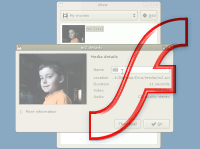
Things to note while watching the demo:
- The thumbnail generation has been specifically slowed-down to demonstrate the magnificent-thread-based-frame-cache capabilities. Normally the thumbnails are generated so fast that you can’t see the timer icon.
- This window will be integrated in the main interface. No MDI.
- I hope to integrate “My photos” and “My music” with the databases of other popular GNOME software (F-spot, Rhythmbox, Sonance, etc…)
7 Comments
What kind of insane way of posting a flash demo is that? If you don’t have the bandwidth stick it on sourceforge or something. That is just beyond stupid.
Cool down man. This is a nice idea and I gladly did that. BTW, the demo is twice as small when compressed and that was my reason in the first place.
Well it looks very nice. I just splutter when people do inexplicable things… another trick for future reference is the coral cache. Google for it, it is pretty cool.
In the last three years you programmer guys discovered that it is very unpractical to manage 20.000 pictures or MP3s just in a hierarchical filesystem and attaching filename to a file.
By scratching this itch, you now develop applications for each problem. But the problem you have managing thousands of files (=objects) you have also with email, bookmarks, sound, picture, …
Why not go for a good solution.
As you are programmers, you are trained to find solutions within your knowlede and within your tools and within your tradition. And this might be the reasond why you dont see the simple solutions.
This might be the reason why cars are designed by designers and not mechanical engineers.
I tried to figure out a solution for managing tens of thousands of objects many years ago and came to the following solution.
x) hide the hierarchical filesystem!!! x) allow the user to define tags (like in gmail) x) allow the user to attach as many tags as he wants to objects x) make a user interface where a user can define a set of tags as a filter (like in gmail, but just more powerfull) x) view in a list all objects which fulfill the filter criteria x) allow the user to navigate this list of objects (of different document type) very fast by pressing the down and up arrow key x) show the thumbnail of the actual seleted object of the list in a preview window (preload and prerender the previous and next item in the list so that the browsing of the list content can be really fast!)
allow parameterised tags (like “size of picture is”)
attach to the objects automatically tags which can be derived automatically (like day of creation, resolution, duration, album title)
I think the most important part of such a solution is the interface to define the filters of tags and the tag managment.
I did a prototype of such a system as a webapplication with PostgreSQL 5 years ago. The browsing of 50000 objects (picture and audio files and emails and html documents) was fast enought, but I would recommend to implement such a system on top of ReiserFS4.
The prototype application was very powerfull and very easy to learn and use (it missed drag and drop for tag addition to objects).
I am open to discuss the concept/issue with anyone serious intererested.
have fun
yours
ed
Very nice idea, indeed. Have you checked google’s/msn’s desktop search? oh, and… how exactly is this post related to Diva???
I think it’s related to the thing I said about integrating “my photos”/”my music” with databases of other GNOME software. If we had a tag-based fs that wouldn’t be necessary.
I like the idea too, though I think that metadata-based solutions (spotlight , beagle) are better in a longer run. This is because they don’t require existing software to be redesigned from stratch. Applications can be gradually upgraded to support beagle, and perhaps one day it’ll become the standard tool for all the file system browsing/finding needs.
I don’t know much about Spotlight, but one thing I lack in Beagle (in terms of design) is “linking” (or rather - “trackbacking”). Think about the following situation:
I just received an e-mail from my friend Max. This e-mail contains an attachment (say: a photo). It’s three “objects” from the search point of view:
Now, each object should contain a “trackback” to the parent object. So for example: if I find the photo object, I can easily see that it “belongs” to the letter, and the letter belongs to “Max”. Similarly, all the “parents” contain links to children (so I can see all the stuff that “Max” is a parent of). The “links” are not required to form any top-down hierarchy. They can even loop themselves. They could be used to build a nice, mind-map like navigation engine.
For that sort of “trackback” linking take a look at dashboard and the “cluepacket chaining” that it does.
http://www.nat.org/dashboard/
It goes a step further, though, and automatically infers relevance so you get objects that don’t just “belong” together but also those related by content (same words in subject line, e.g.) or metadata (you had both documents open at the same time yesterday, e.g.).
The mailing list seems (from a quick look at the subject lines) to be all about Beagle these days though.
http://mail.gnome.org/archives/dashboard-hackers/2005-August/thread.html
Sorry, comments are closed for this article.